Introduction: Why Industrial Solar Is Different from Home Solar?
If you are a factory owner or industrial plant head evaluating solar energy, here is the first thing you need to understand: an industrial solar plant installation process has almost nothing in common with a 3kW rooftop system on a house. The scale, engineering complexity, regulatory framework, and risk profile are fundamentally different.
A 500kW system on a factory roof in Sitapura Industrial Area, Jaipur, involves structural load calculations on pre-engineered buildings, shadow analysis across multiple roof elevations, HT/LT panel integration with existing electrical infrastructure, DISCOM synchronization approvals, CEIG clearances for systems above 500kW, and ongoing performance monitoring through SCADA. None of this applies to residential solar.
This guide is written from the perspective of an EPC contractor who has executed industrial solar projects across Rajasthan. Every step described here is based on actual project execution, not textbook theory. Whether you are evaluating a 100kW rooftop system for your warehouse or a 5MW ground-mounted plant for your manufacturing facility, this is your complete reference.
Step 1: Site Survey and Feasibility Study
Every industrial solar project starts with a physical site visit. No amount of Google Earth imagery replaces boots on the ground. Here is what a proper site survey covers:
Roof assessment (for rooftop projects): Roof type (RCC, metal sheet, PEB), age, structural condition, available shadow-free area, parapet height, existing rooftop equipment (HVAC units, cooling towers, exhaust systems), and access points for cable routing.
Ground assessment (for ground-mounted projects): Soil type, topography, water table level, land ownership documents, approach road availability, proximity to the nearest substation or transformer, and any environmental restrictions.
Electrical assessment: Existing sanctioned load, connected load, HT/LT supply details, transformer capacity, main panel configuration, power factor, and monthly consumption data from the last 12 months of electricity bills.
Regulatory check: DISCOM jurisdiction (JVVNL / AVVNL / JdVVNL in Rajasthan), net metering eligibility, open access feasibility for larger plants, and any local building bylaws or height restrictions.
A competent solar EPC contractor in Jaipur will complete this survey and deliver a feasibility report within 5-7 working days, including preliminary capacity recommendation and ROI estimate.
Step 2: Load Analysis and Capacity Planning
How to Calculate Solar Plant Capacity for Your Factory
This is the most critical decision in your solar project, and it is where most factory owners make their first mistake. Here is the systematic approach:
Collect consumption data: Get 12 months of electricity bills. Note monthly units consumed (kWh), peak demand (kVA), and time-of-day consumption patterns.
Calculate annual consumption: Sum all 12 months. Example: If your Sitapura factory consumes an average of 75,000 units/month, your annual consumption is 9,00,000 kWh.
Determine solar generation potential: In Rajasthan, 1 kWp of solar generates approximately 1,500-1,600 kWh per year (CUF of 17-18% for rooftop). For ground-mounted with tracking, this can go up to 1,800 kWh.
Size the plant: Divide annual consumption by per-kWp generation. Example: 9,00,000 / 1,550 = approximately 580 kWp. A 600kW system would be the practical recommendation, accounting for degradation and losses.
Cross-check with sanctioned load: Under Rajasthan net metering regulations, your solar plant capacity cannot exceed your sanctioned load. If your sanctioned load is 500kVA, your solar plant should be sized up to 500kWp under net metering.
Mini Case Scenario: 500kW Rooftop Solar for a Textile Factory, RIICO Jaipur
A textile manufacturing unit in RIICO Industrial Area, Jaipur, has a sanctioned load of 600kVA and average monthly consumption of 62,000 units. The factory operates on a PEB structure with a metal sheet roof.
Recommended capacity: 500kWp rooftop solar.
Expected annual generation: 7,50,000 to 8,00,000 kWh.
Estimated savings: Rs. 55-60 Lakhs per year (at Rs. 7.5/unit industrial tariff).
Payback period: 3.5 to 4 years.
Roof area required: Approximately 5,000 sq. meters (10 sq. m per kWp).
Step 3: Design and Engineering
This is where the EPC contractor earns their fee. Proper design engineering separates a high-performing plant from a problematic one.
Module layout design: Using PVsyst or equivalent software, the engineering team designs the module arrangement considering roof geometry, obstacles, walkway clearances (minimum 600mm), and orientation. True south is ideal, but east-west layouts are common on narrow industrial roofs.
Shadow analysis: 3D shadow simulation across all 12 months. Shadows from parapets, adjacent buildings, cooling towers, and overhead tanks must be mapped. Even 5% shading on a string can reduce output by 20-30%.
String sizing and configuration: Based on module electrical characteristics, ambient temperature range (Jaipur can hit 48 degrees Celsius in summer), and inverter MPPT voltage window.
Single Line Diagram (SLD): Complete electrical schematic from modules to the point of grid interconnection, showing string combiner boxes, DC cables, inverters, AC distribution boards, energy meter, isolation devices, and protection relays.
Structural design: Module mounting structure design with wind load calculations (as per IS 875 Part 3), dead load calculations, and compatibility with existing roof structure. For PEB roofs, purlins and rafter loading must be verified.
Cable sizing and routing plan: DC and AC cable sizing based on current carrying capacity, voltage drop (maximum 2% on DC side, 1% on AC side), and ambient temperature derating.
Step 4: Approvals (DISCOM, Net Metering, CEIG)
DISCOM Approvals and Net Metering Process in Rajasthan
Rajasthan follows the RERC (Rajasthan Electricity Regulatory Commission) net metering regulations. The solar net metering process in Rajasthan involves these stages:
Stage 1 – Application: Submit net metering application to the respective DISCOM (JVVNL for Jaipur) along with project details, SLD, undertaking, and processing fee.
Stage 2 – Technical feasibility: DISCOM evaluates transformer capacity, feeder loading, and grid stability. Approval or modification suggestions are issued within 15-30 days.
Stage 3 – Agreement execution: Sign the net metering agreement with DISCOM after receiving technical approval.
Stage 4 – Post-installation inspection: After installation, DISCOM conducts a physical inspection. Upon clearance, a bi-directional meter is installed.
Stage 5 – Synchronization: The solar plant is synchronized with the grid, and net metering begins.
For systems above 500kW (or as per state regulations), CEIG (Chief Electrical Inspector to Government) approval is additionally required. This involves submission of SLD, protection relay settings, earthing scheme, and a physical inspection before energization.
Documents Required for Industrial Solar Project (India)
| Document |
Required For |
Submitted To |
| Electricity bills (12 months) |
Load analysis & sizing |
EPC Contractor |
| Sanctioned load letter |
Capacity validation |
DISCOM |
| Property ownership / lease deed |
Site eligibility |
DISCOM |
| Roof structural drawing / soil report |
Structural design |
EPC Contractor |
| Net metering application form |
Grid interconnection |
DISCOM (JVVNL) |
| Single Line Diagram (SLD) |
Technical approval |
DISCOM / CEIG |
| Module & inverter datasheets |
Technical compliance |
DISCOM |
| Undertaking (self-consumption) |
Regulatory compliance |
DISCOM |
| CEIG application (if >500kW) |
Safety clearance |
CEIG Rajasthan |
| Insurance certificate |
Risk coverage |
EPC Contractor / Bank |
| GST registration |
Tax & subsidy |
MNRE / Nodal agency |
Step 5: Procurement (BOM, Module & Inverter Selection)
Procurement in an industrial solar project is not about buying the cheapest components. It is about selecting the right Bill of Materials (BOM) that balances performance, reliability, bankability, and warranty enforceability.
Solar Plant Components Checklist (with Specifications)
| Component |
Specification Range |
Key Selection Criteria |
Typical Brand Tier |
| Solar modules |
540-580Wp, Mono PERC/TOPCon, Bifacial |
ALMM listed, Tier-1, BIS certified |
Tier-1 (Adani, Vikram, Waaree, Trina) |
| Inverters (string type) |
50-110kW, 3-phase, multiple MPPT |
IP65, wide MPPT range, MNRE approved |
Tier-1 (Sungrow, Huawei, Growatt, ABB) |
| Inverters (central) |
250kW-1MW+ |
For large ground-mounted systems |
Tier-1 (Sungrow, SMA, TMEIC) |
| Mounting structure |
Hot-dip galvanized steel, 120+ micron |
IS 2062 Grade E250, wind zone compliant |
Custom fabricated / branded |
| DC cables |
1.5kV rated, 4/6 sq mm, DC solar cable |
TUV certified, UV resistant, tinned copper |
Polycab, KEI, Havells |
| AC cables |
1.1kV XLPE, armoured |
IS 7098 compliant, sized per load |
Polycab, KEI, Finolex |
| String combiner box (SCB) |
IP65, SPD, fuses, DC disconnect |
Rated for string current, touch-safe |
Custom / Hensel / Elmex |
| AC distribution board (ACDB) |
IP54, MCCB, SPD, metering CT |
Rated for inverter output |
Schneider, L&T, ABB |
| Energy meter |
Bi-directional, Class 0.5s, CT operated |
DISCOM approved make |
Secure, L&T, HPL |
| Earthing materials |
GI pipe, copper strip, maintenance-free |
IS 3043 compliant |
As per design |
| Lightning arrestor |
ESE type, Class 1 SPD |
IEC 62305 compliant |
Indelec, Erico, OBO |
| SCADA / monitoring |
Cloud-based, inverter-level monitoring |
Real-time alerts, PR tracking |
Sungrow iSolar, Huawei FusionSolar |
Step 6: Civil and Structure Work
For rooftop systems, this involves installing the module mounting structures (MMS) on the existing roof. For ground-mounted plants, it includes foundation work, pile driving, and structure erection.
Rooftop MMS: Structures are typically fixed-tilt (10-15 degrees in Rajasthan) using ballast-mounted or clamp-on systems for metal roofs. For RCC roofs, chemical anchor bolts are used. The structure design must account for Jaipur’s wind zone (Zone IV, basic wind speed 47 m/s).
Ground-mounted foundations: Typically driven piles (ramming or screw piles) based on soil report. Foundation depth is determined by soil bearing capacity. In Rajasthan’s sandy soil, driven piles of 1.5-2m depth are common.
Cable trenching: Trench dimensions, sand bedding, cable protection (PVC conduit or RCC covers), and route planning to minimize cable length.
Step 7: DC Side Installation (Modules, Strings, Cable Routing)
The DC side is where power is generated. Precision here directly impacts plant performance for 25 years.
Module mounting: Modules are mounted on the MMS using mid-clamps and end-clamps, with torque settings as per manufacturer specifications. Proper gap between modules (typically 20-25mm) is maintained for thermal expansion and drainage.
String formation: Modules are connected in series to form strings. String voltage must stay within the inverter MPPT window across all temperature conditions. In Jaipur’s climate (ranging from 5 degrees Celsius in winter to 48 degrees Celsius in summer), this temperature correction is critical.
DC cable routing: Solar DC cables are routed through cable trays (perforated GI or aluminium) along the structure. Cable management includes proper bending radius, UV-resistant cable ties, and labelling of positive and negative cables at every junction.
String combiner boxes: Strings terminate in SCBs with fuse protection, SPD (surge protection devices), and DC disconnect switches. Each SCB is clearly labelled.
Step 8: AC Side Installation (Inverters, LT Panels, Transformers)
The AC side converts DC power from modules to grid-compatible AC power and integrates it with the factory’s electrical system.
Inverter installation: String inverters are mounted on dedicated structures near the module arrays (minimizing DC cable length). Adequate ventilation space (minimum 300mm on all sides) and protection from direct rain/sunlight are essential. Central inverters are installed in dedicated rooms or containers.
AC distribution board (ACDB): Receives output from multiple inverters, provides MCCB protection, surge protection, and CT connections for energy metering. The ACDB is typically installed near the factory’s main LT panel.
Transformer (if applicable): For HT-connected factories, a dedicated solar step-up transformer (LT to HT) may be required. This is integrated with the existing HT panel/substation. VPB Infratech handles both solar and HT/LT electrical integration, which eliminates coordination issues between multiple contractors.
Grid interconnection: Solar output is connected to the factory’s main panel through a dedicated breaker, with interlocking and anti-islanding protection as per DISCOM requirements.
Step 9: Earthing and Lightning Protection
This is arguably the most under-appreciated aspect of industrial solar installation. Poor earthing is the number one cause of inverter failures and safety hazards.
Equipment earthing: Every module frame, mounting structure, inverter body, combiner box, and ACDB enclosure must be connected to the earth grid. Copper bonding strips or green-yellow earth cables are used for connections.
System earthing: The inverter neutral is earthed as per the earthing scheme (TN-S or TT system). Earth resistance must be less than 1 ohm for equipment earth and less than 5 ohms for lightning protection earth.
Lightning protection: For industrial-scale plants, a lightning protection system as per IEC 62305 is essential. This includes air termination (ESE lightning arrestors or Franklin rods), down conductors, and a dedicated earth pit network separate from the equipment earth.
SPD installation: Type 1 SPD at the main panel, Type 2 SPD at inverter input/output, and Type 2/3 SPD at ACDBs. SPD earth connections must be as short as possible (under 500mm lead length).
Best Practices for Earthing (Rajasthan-Specific)
Rajasthan’s soil is predominantly sandy with high resistivity. In areas like RIICO Jaipur or VKI Industrial Area, earth pit resistance can be challenging to achieve. Use maintenance-free chemical earthing electrodes (gel/bentonite backfill) instead of conventional CI pipe earthing. These maintain consistent resistance even in dry conditions, which is critical for Rajasthan’s arid climate.
Step 10: SCADA and Monitoring Setup
A monitoring system is non-negotiable for industrial solar plants. Without real-time data, you cannot verify performance, detect faults, or hold your EPC contractor accountable for generation guarantees.
Inverter-level monitoring: Most Tier-1 inverters come with built-in monitoring through their cloud platform (e.g., Sungrow iSolar, Huawei FusionSolar). This provides real-time generation data, inverter status, and basic fault alerts.
String-level monitoring: For plants above 200kW, string-level monitoring helps identify underperforming strings quickly. This requires string monitoring devices (SMDs) at combiner boxes.
Weather station: A local weather station (GHI sensor, ambient temperature, module temperature, wind speed) allows accurate Performance Ratio (PR) calculations.
SCADA integration: For plants above 1MW, a full SCADA system with data logging, report generation, alarm management, and remote control is standard practice.
Step 11: Testing, Commissioning and Synchronization
Solar Plant Commissioning Process
Commissioning is the systematic verification that every component is installed correctly and the plant is safe to operate. This is where shortcuts cause long-term problems.
QA Checklist During Installation
| Sr. No. |
Check Item |
Standard |
Status |
| 1 |
Module visual inspection (micro-cracks, frame damage) |
IEC 61215 |
Pass / Fail |
| 2 |
String open circuit voltage (Voc) measurement |
Within +/- 2% of design |
Pass / Fail |
| 3 |
String short circuit current (Isc) measurement |
Within +/- 3% of design |
Pass / Fail |
| 4 |
String polarity verification |
Positive / Negative correct |
Pass / Fail |
| 5 |
DC cable insulation resistance (IR) test |
> 1 MOhm per string |
Pass / Fail |
| 6 |
Cable tightness and torque verification |
As per manufacturer specs |
Pass / Fail |
| 7 |
Earthing continuity test |
< 0.5 Ohm bonding resistance |
Pass / Fail |
| 8 |
Earth pit resistance measurement |
< 1 Ohm (equipment), < 5 Ohm (LA) |
Pass / Fail |
| 9 |
Inverter parameter settings verification |
As per design SLD |
Pass / Fail |
| 10 |
AC cable insulation resistance test |
> 1 MOhm |
Pass / Fail |
Commissioning Checklist
| Sr. No. |
Test / Check |
Acceptance Criteria |
Result |
| 1 |
Insulation resistance (IR) test – DC strings |
> 1 MOhm at 1000V DC |
_____ MOhm |
| 2 |
Insulation resistance (IR) test – AC cables |
> 1 MOhm at 500V DC |
_____ MOhm |
| 3 |
Earth resistance measurement (all pits) |
< 1 Ohm (equipment earth) |
_____ Ohm |
| 4 |
Earth continuity test (structure to earth bus) |
< 0.5 Ohm |
_____ Ohm |
| 5 |
Relay testing (over/under voltage, frequency) |
As per DISCOM settings |
Tested / Not tested |
| 6 |
Anti-islanding test |
Inverter trips within 2 seconds |
_____ seconds |
| 7 |
Inverter synchronization test |
Grid sync within 60 seconds |
Pass / Fail |
| 8 |
CT ratio and metering accuracy verification |
Within +/- 0.5% accuracy |
Pass / Fail |
| 9 |
Full load generation test (4 consecutive sunny hours) |
Generation within 90% of design |
_____ kWh |
| 10 |
Thermal imaging of all connections and strings |
No hotspots above 10 deg C differential |
Pass / Fail |
Step 12: Performance Verification
After commissioning, the plant enters a performance verification period (typically 30-90 days). Key metrics to track:
Performance Ratio (PR): The ratio of actual energy output to theoretically possible output. A well-executed industrial plant in Rajasthan should achieve a PR of 78-82% in the first year.
Specific yield: kWh generated per kWp installed. For Jaipur, expect 1,500-1,600 kWh/kWp/year for fixed-tilt rooftop systems.
Capacity Utilization Factor (CUF): Typically 17-19% for rooftop and 19-22% for ground-mounted (with tracking) in Rajasthan.
System losses: DC cable losses (under 2%), AC cable losses (under 1%), soiling losses (2-5% average, higher in dusty industrial areas), temperature losses (8-12% in Rajasthan summer), and inverter efficiency losses (1.5-3%).
Step 13: Handover and O&M Plan
Project handover is not just handing over keys. A proper handover from an industrial solar EPC company includes:
As-built documentation: Updated SLD, layout drawings, cable schedule, equipment location plans, and earthing layout reflecting actual installation.
Test reports: All commissioning test reports, IR test certificates, earthing test certificates, and relay test reports.
Warranty documents: Module warranty cards (25-year performance warranty), inverter warranty certificates (5-10 years), and structure warranty.
O&M manual: Detailed maintenance schedule, troubleshooting guide, and emergency shutdown procedures.
Training: On-site training for the factory’s electrical team on basic monitoring, alarm response, and safety procedures.
O&M Guide: What Happens After Installation?
Monthly Tasks
Module cleaning (frequency depends on dust levels; in Rajasthan’s industrial areas, bi-weekly to monthly). Visual inspection of cables, connectors, and structure. Generation data review against benchmarks. Inverter error log review.
Quarterly Tasks
Thermal imaging of all DC connections, string combiner boxes, and AC panels. String-level I-V curve testing (sample basis). Earth resistance measurement. Inverter filter cleaning. Tightness check of all mechanical and electrical connections.
Annual Tasks
Comprehensive plant audit including PR calculation, module-level inspection, structure integrity check, detailed electrical testing, and generation guarantee reconciliation. Inverter firmware update (if available). Lightning protection system inspection.
Project Timeline: Industrial Solar EPC Workflow
Below is a typical timeline for a 500kW industrial solar rooftop project in Rajasthan:
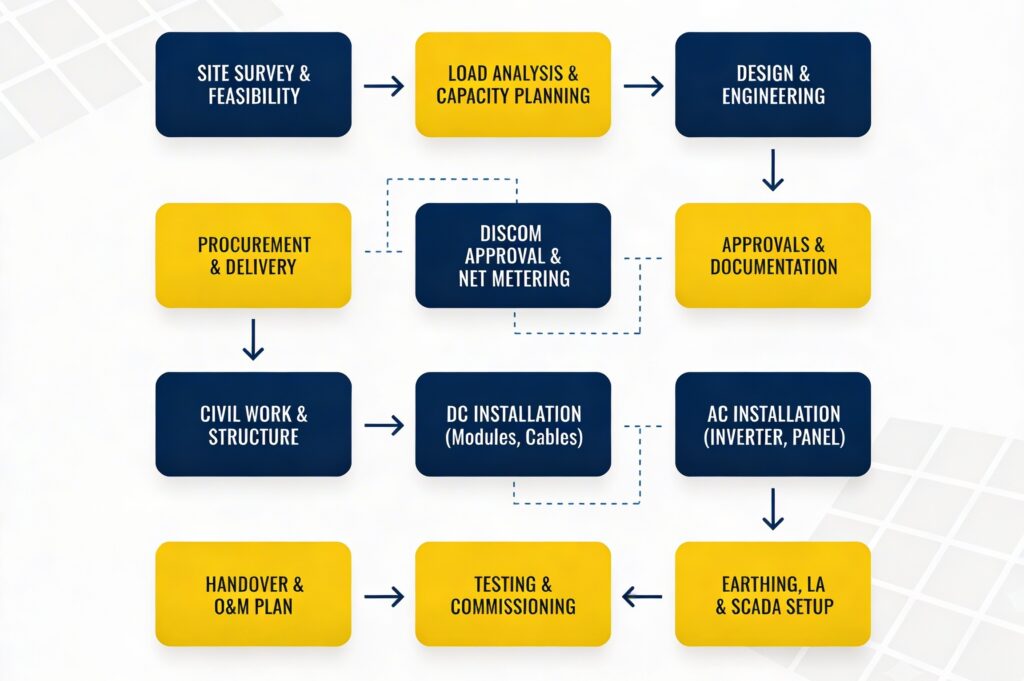
INDUSTRIAL SOLAR EPC PROJECT TIMELINE (500kW ROOFTOP – TYPICAL
| Timeline |
Key Activities |
Deliverables |
| Week 1-2 |
Site Survey + Feasibility Study + Load Analysis |
Feasibility Report, Capacity Recommendation |
| Week 3-4 |
Detailed Design & Engineering (SLD, Layout, Shadow Analysis) |
Design Package, BOM |
| Week 3-6 |
DISCOM Application + Net Metering Approval (Runs Parallel) |
Technical Feasibility Letter |
| Week 5-7 |
Procurement + Material Delivery to Site |
All materials at site with test certificates |
| Week 7-8 |
Structure Erection + Civil Work |
Structure ready for module mounting |
| Week 8-10 |
Module Mounting + DC Cabling + String Formation |
DC side complete, strings tested |
| Week 10-11 |
Inverter Installation + AC Wiring + Panel Connections |
AC side complete, ready for testing |
| Week 11-12 |
Earthing + Lightning Protection + SCADA Setup |
Safety systems operational |
| Week 12-13 |
Testing + Commissioning + DISCOM Inspection |
Plant commissioned, meter installed |
| Week 13-14 |
Synchronization + Handover + O&M Training |
Plant generating, documentation handed over |
EPC Workflow Flowchart
Cost Breakup: Industrial Solar Plant (Indicative)
Note: These are indicative ranges as of early 2026 and vary based on project size, component selection, and site conditions. Prices exclude GST.
| Component / Item |
Cost Range (per Wp) |
% of Total Cost |
| Solar modules (Tier-1, DCR compliant) |
Rs. 18-24 per Wp |
45-55% |
| Inverters (string / central) |
Rs. 2.5-4 per Wp |
7-10% |
| Mounting structure (MMS) |
Rs. 3-5 per Wp |
8-12% |
| Electrical BOS (cables, panels, SCB, ACDB) |
Rs. 2-3.5 per Wp |
6-9% |
| Earthing & lightning protection |
Rs. 0.5-1 per Wp |
1-3% |
| Civil work & labour |
Rs. 2-4 per Wp |
6-10% |
| SCADA & monitoring |
Rs. 0.3-0.8 per Wp |
1-2% |
| Design, engineering & project management |
Rs. 1-2 per Wp |
3-5% |
| Approvals, testing & commissioning |
Rs. 0.5-1 per Wp |
1-3% |
| TOTAL (EPC turnkey) |
Rs. 32-42 per Wp |
100% |
For a 500kW plant, this translates to approximately Rs. 1.6 to 2.1 Crores total project cost (turnkey, excl. GST).
Rooftop vs Ground-Mounted: Industrial Decision Guide
| Parameter |
Rooftop Solar |
Ground-Mounted Solar |
| Typical capacity |
50kW to 2MW |
500kW to 50MW+ |
| Land requirement |
Uses existing roof (no extra land) |
Requires dedicated open land |
| Cost per Wp |
Rs. 32-40 (lower civil cost) |
Rs. 35-45 (higher civil + land cost) |
| Generation (CUF) |
17-19% (fixed tilt) |
19-22% (with seasonal / single-axis tracking) |
| Structural risk |
Dependent on roof condition and age |
Independent (own foundation) |
| Shadow challenges |
Parapets, cooling towers, adjacent buildings |
Minimal (proper row spacing) |
| O&M ease |
Harder (roof access, safety harness) |
Easier (ground-level access) |
| Best for |
Factories with large, strong roofs |
Open land available near factory |
| Net metering |
Eligible (up to sanctioned load) |
Eligible (up to sanctioned load) |
| Typical payback |
3-4.5 years (Rajasthan) |
4-5.5 years (higher initial cost) |
| Approval complexity |
Standard net metering |
May need land-use change, EA clearance |
| Recommended in Jaipur for |
RIICO, Sitapura, VKI factories |
Outskirts, Phulera, Chomu belt |
Common Mistakes Factory Owners Make
- Choosing the cheapest EPC contractor: Solar is a 25-year investment. An inexperienced contractor saves you Rs. 2-3 per Wp upfront but costs you lakhs in lost generation, repeated repairs, and warranty disputes. Ask for reference projects, visit completed installations, and verify their electrical license.
- Ignoring structural load assessment: We have seen factories where solar was installed on PEB roofs without verifying purlin capacity. The roof started sagging within two monsoons. Always get a structural engineer’s certification before rooftop installation.
- Oversizing without checking sanctioned load: If your sanctioned load is 400kVA and you install 600kW solar, DISCOM will reject your net metering application. Verify sanctioned load before finalizing capacity.
- Neglecting shadow analysis: A factory in Mansarovar Industrial Area lost 18% generation because nearby cooling towers were not accounted for in the design. Proper 3D shadow analysis is not optional.
- Skipping earthing quality checks: In Rajasthan’s sandy soil, achieving low earth resistance is difficult. Cheap earthing materials fail within 2-3 years, leading to inverter failures and safety hazards. Invest in maintenance-free chemical earthing.
- No written performance guarantee: Your EPC contract must include a specific generation guarantee (kWh/year) with a penalty clause. Without this, you have no recourse if the plant underperforms.
- Ignoring O&M from day one: A solar plant without regular maintenance loses 1-2% efficiency per year from soiling alone in dusty industrial zones. Include AMC in your project planning from the start.
- Not verifying ALMM listing: The Approved List of Models and Manufacturers (ALMM) is mandatory for government-subsidized or net-metered projects. Using non-ALMM modules can disqualify your project.
- Delaying DISCOM application: Start the DISCOM application process in parallel with design, not after installation. Net metering approval can take 30-60 days and delays here stall your entire project.
- No monitoring system: Without a monitoring system, you will not know if your plant is underperforming until you see your electricity bill. Real-time monitoring pays for itself within the first year.
Frequently Asked Questions (FAQs)
Q1: How long does an industrial solar plant installation take?
A typical 500kW rooftop solar plant takes 12-14 weeks from site survey to commissioning. Larger ground-mounted projects (1-5MW) can take 4-6 months. The DISCOM approval process often determines the overall timeline.
Q2: What is the cost of a 500kW industrial solar plant in Jaipur?
As of 2026, a 500kW rooftop solar plant in Jaipur costs approximately Rs. 1.6 to 2.1 Crores (turnkey, excl. GST), depending on component selection and site conditions. Ground-mounted systems cost 10-15% more due to additional civil work.
Q3: Is net metering available for industrial consumers in Rajasthan?
Yes, net metering is available for industrial consumers under RERC regulations. The solar plant capacity must not exceed your sanctioned load. Apply through your respective DISCOM (JVVNL for Jaipur division). The solar net metering process in Rajasthan typically takes 30-60 days for approval.
Q4: What is the payback period for industrial solar in Rajasthan?
At current industrial tariff rates of Rs. 7-8.5 per unit and Rajasthan’s high solar irradiance, the typical payback period is 3-4.5 years for rooftop systems. This makes it one of the best ROI investments available for factories.
Q5: Do I need CEIG approval for my solar plant?
CEIG approval is required for solar plants above 500kW (or as per applicable state regulations) that connect to the grid. This involves submission of SLD, protection schemes, and a physical inspection. Your solar EPC contractor should handle this process.
Q6: What maintenance does an industrial solar plant need?
Regular module cleaning (bi-weekly to monthly in dusty areas), quarterly thermal imaging and electrical testing, and annual comprehensive audits. In Rajasthan, dust and heat are the primary challenges. A good AMC costs Rs. 0.4-0.8 per Wp per year.
Q7: Can I install solar on a PEB (pre-engineered building) roof?
Yes, but only after a structural load assessment confirms the roof can handle the additional weight (typically 12-15 kg per sq. meter for solar). Many PEB roofs in RIICO Jaipur have been successfully fitted with solar using lightweight mounting systems.
Q8: What is the difference between string inverters and central inverters?
String inverters (50-110kW each) offer better partial shading performance and easier maintenance, ideal for rooftop systems up to 2MW. Central inverters (250kW+) are more cost-effective for large ground-mounted plants above 1MW but require dedicated rooms and have higher single-point failure risk.
Q9: How do I select the right solar EPC contractor?
Check their track record (completed projects with references), electrical contractor license, financial stability, MNRE empanelment, component sourcing (Tier-1 brands only), written performance guarantee in the contract, and local presence for O&M support. A rooftop solar EPC contractor in Jaipur with local experience will understand DISCOM processes and site-specific challenges better.
Q10: What happens to solar generation during Rajasthan’s dust storms?
Dust storms temporarily reduce generation and increase soiling losses. However, Rajasthan’s high irradiance levels more than compensate over the year. Post-storm cleaning (within 24-48 hours) restores full generation. Bifacial modules and higher tilt angles help mitigate soiling losses.
Conclusion
An industrial solar plant is not a commodity purchase. It is a 25-year infrastructure investment that directly impacts your factory’s operating costs, energy security, and environmental footprint. The difference between a well-executed plant and a problematic one lies entirely in the EPC process: thorough site assessment, precise engineering, quality procurement, disciplined execution, and systematic commissioning.
If you have read this entire guide, you now have more knowledge about the industrial solar plant installation process than 90% of factory owners who sign EPC contracts. Use this knowledge to ask the right questions, demand proper documentation, and hold your contractor accountable.
VPB Infra Tech Pvt. Ltd. provides turnkey industrial solar EPC in Jaipur and across Rajasthan, including design, DISCOM approvals, execution, and commissioning. Free site visit and project estimate available.